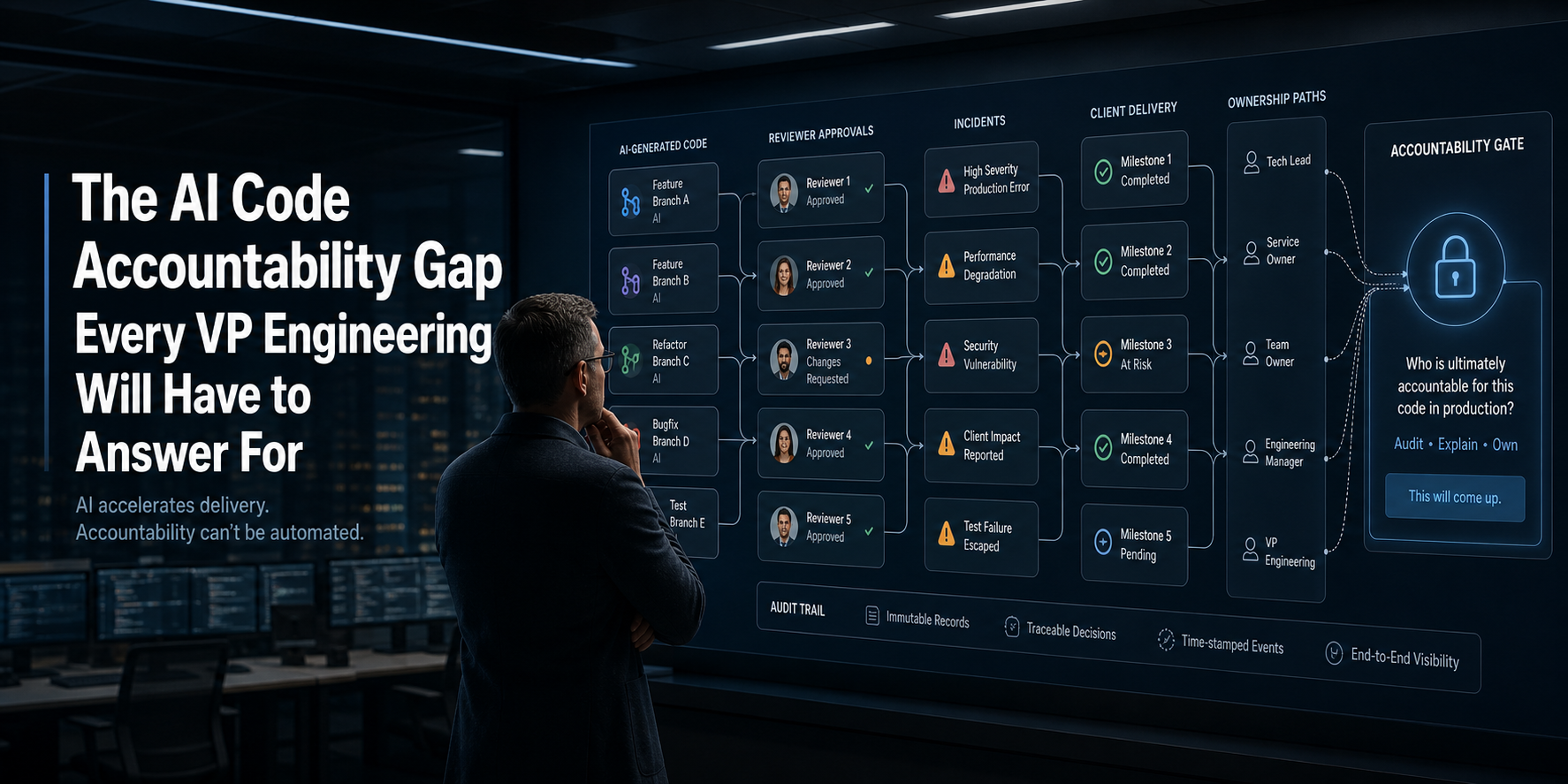
At some point, a customer, board member, security reviewer, or incident lead will ask a simple question:
Who approved this AI-written code?
Not who generated it. Not which model produced the first draft. Not whether the prompt sounded reasonable.
Who owned the decision that this change was safe enough to ship?
That is the AI code accountability gap. It is small while teams are experimenting. It becomes impossible to ignore when agent-written code starts touching production systems and client commitments.
The Model Cannot Sit In The Incident Review
Engineering leaders already know this, but it deserves to be said plainly: AI cannot carry operational accountability.
If a generated change breaks billing, leaks data, slows a customer workflow, or silently corrupts a migration, the incident review will not end with "the agent did it."
The team owns the production outcome. The tech lead owns the technical judgment. The VP Engineering owns the system that allowed the change to ship.
For software service companies, the pressure is even sharper. Clients do not buy "we used AI" as an excuse. They buy delivery confidence.
AI can write code. Your organization still signs the work.
The Accountability Chain Is Getting Blurry
Traditional software delivery had a relatively clear chain. A developer made a change. A reviewer approved it. CI ran. Someone merged. The release process moved it forward.
Agentic development adds new actors and new ambiguity.
An agent may interpret the ticket, inspect the repository, change multiple files, add tests, and open a pull request. GitHub's Copilot coding agent documentation describes exactly this kind of workflow: agents can work on assigned issues, create branches, make changes, and prepare pull requests for human review.
That does not remove the human decision point. It makes the decision point more important.
The problem is that many teams are adopting AI at the coding layer without updating the accountability layer. They know who clicked merge. They may not know what evidence that person had.
Approval Is Not The Same As Accountability
A pull request approval is an important signal. It is not the whole accountability story.
GitHub's Copilot code review documentation makes a useful distinction: AI review comments can help, but they do not count as required approvals. Human review still matters because accountability is not just pattern detection. It is judgment.
Judgment needs context. What was the agent asked to do? What did it actually inspect? Which checks passed? Which checks were not run? Which risk areas are still unresolved?
Without that evidence, the reviewer is approving a diff while guessing at the path that produced it.
VP Engineering Needs An Answer Before The Question Arrives
The risky move is to wait until a customer asks.
By then, the answer needs to be crisp. "We use AI carefully" will not be enough. Neither will "our engineers review everything." Those statements may be true, but they are too vague to build trust.
A stronger answer sounds more like this:
- We identify which changes are agent-heavy.
- We preserve the task, prompt, changed files, commands, tests, failures, and risk notes.
- We require human review for production changes.
- We make validation evidence visible before approval.
- We keep ownership clear after merge.
That answer is not just compliance theater. It helps reviewers move faster because they can see the trail instead of reconstructing it.
What The Accountability Layer Should Capture
The accountability layer should be lightweight enough for developers to accept and structured enough for leaders to trust.
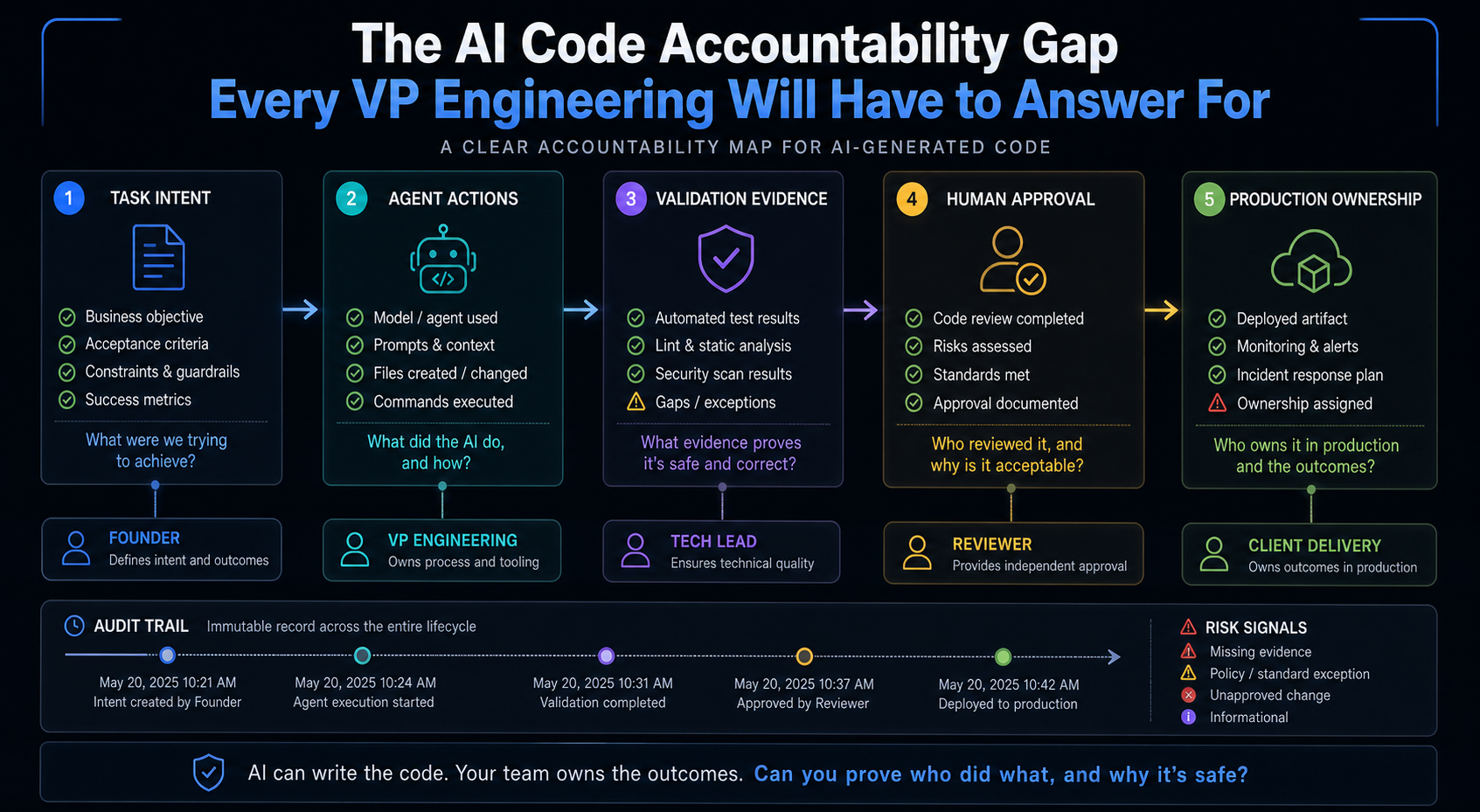
At minimum, it should preserve five things:
- Intent: the task, constraints, acceptance criteria, and expected outcome.
- Agent actions: the files inspected, files changed, commands run, and assumptions made.
- Validation evidence: tests, checks, failures, skipped checks, and known gaps.
- Human judgment: who reviewed the work, what they focused on, and why approval was reasonable.
- Production ownership: who owns the deployed change, monitoring, rollback, and client communication if something goes wrong.
This is not about slowing teams down. It is about making speed governable.
The Future Client Question
Every software service company should prepare for this question:
How do you manage AI-generated code in our project?
The weakest answer is tooling theater: a list of models and editors.
The strongest answer is operational: here is how we decide what AI can touch, here is the evidence we capture, here is who approves the work, and here is who owns it in production.
The winning teams will not be the ones that merely use AI. They will be the ones that can prove how they use it safely.