
The first thing teams notice about AI coding is speed.
A developer asks for a change. The agent reads files, edits code, runs a command or two, and produces a branch. What used to take an afternoon can sometimes land before the next meeting.
That feels like leverage. Often, it is.
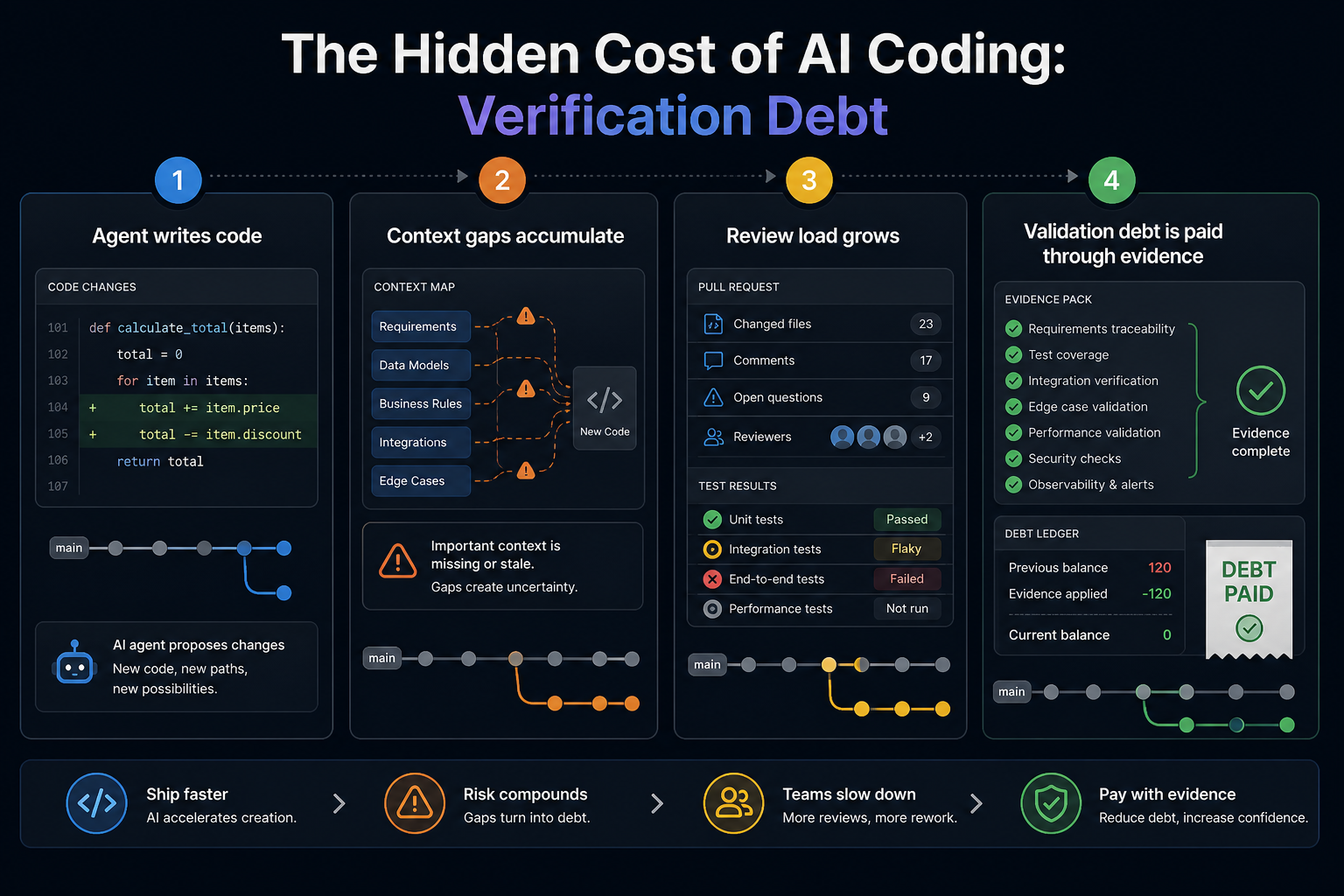
But the second-order effect is quieter. Every generated change still has to be understood, validated, reviewed, merged, shipped, and owned. If the team does not capture evidence while the work is happening, that missing proof gets paid for later.
That is verification debt.
Verification Debt Is Not Technical Debt
Technical debt usually lives in the code. Verification debt lives around the code.
It is the missing context a reviewer has to reconstruct. The test that should have been run but was skipped. The assumption the agent made but never wrote down. The dependency change that looks harmless until a tech lead remembers the downstream service it touches.
In a human-only workflow, some of that context sits in the developer's head. That is not perfect, but it is familiar. Reviewers know who to ask. Developers remember why they changed one path and avoided another.
With agent-written code, the work can move faster than memory. If the workflow does not preserve the evidence, the reviewer receives only the artifact.
AI can reduce coding time and increase the bill for understanding.
The Debt Shows Up In Review
Verification debt does not announce itself as a production incident on day one. It usually appears first as review drag.
A senior engineer opens a pull request and has to answer questions the workflow should have answered already: what task was the agent given, what files did it inspect, which commands ran, which checks failed, and which risks remain?
If the reviewer cannot see that trail, they have two bad options. Trust the diff too quickly, or spend extra time recreating the investigation.
Both options are expensive. The first increases production risk. The second burns senior engineering attention. Software service companies feel this especially hard because delivery speed and client trust live in the same contract.
AI Review Does Not Remove Human Accountability
AI can help review code. It can point out suspicious logic, suggest simpler implementations, or catch obvious mistakes. That is useful.
But tooling boundaries matter. GitHub's documentation for Copilot code review says Copilot comments do not count as required approvals. That is the right signal for leaders: AI can assist the process, but it does not become the accountable reviewer.
The same is true earlier in the workflow. GitHub's Copilot coding agent can work on assigned issues, create branches, make changes, and open pull requests. That expands production capacity. It also increases the need for proof around what happened before review.
What Counts As Paying Down Verification Debt?
Paying down verification debt does not mean asking developers to write essays in every PR.
It means making the useful evidence cheap to capture and hard to lose:
- The original task or prompt the agent worked from
- The files and directories it inspected before editing
- The files it changed and why those files were in scope
- The commands, tests, and checks it ran locally
- The failures it saw before the final passing state
- The assumptions and risk areas that still need human judgment
This evidence should arrive before the reviewer opens the diff. If it arrives only after someone asks, the debt has already started charging interest.
The Wrong Metric Is More PRs
AI adoption can tempt teams into measuring the easiest thing: number of branches, number of PRs, number of generated changes.
Those numbers are activity, not confidence.
The better question is: how many changes reached review with enough evidence for a human to make a fast, sound decision?
For a founder, that is a margin question. For a VP Engineering, it is a systems question. For a services team, it is a client trust question.
What Leaders Should Change
Start with the workflow, not the policy memo.
Pick one team using AI coding heavily. For two weeks, ask reviewers to mark each agent-heavy PR as evidence-ready or evidence-missing. Do not overcomplicate it. Look for patterns.
Which tasks create the most uncertainty? Which tests are repeatedly missing? Which reviewers spend the most time reconstructing context? Which clients or systems deserve a stricter bar?
Then build the evidence trail into the development flow itself.
Fast code is only useful when trust can keep up.