The control plane for agentic development.
Ocean helps engineering teams run coding agents like a real production workflow: every agent gets an isolated lane, every change gets evidence, and every merge stays under human control.
One workbench for every coding agent.
Launch agents, watch their lanes, inspect validation evidence, and approve only the work that is ready for your repo.
A product family for controlled AI coding.
JetBrains has IDEs for every developer workflow. Ocean has control surfaces for every risky part of agentic development.
Workspaces
Give every agent a copy-on-write lane instead of letting parallel sessions collide in your repo.
Validation
Turn tests, type checks, review status, and risk into explicit merge evidence.
Spend
Track agent cost by project, developer, lane, and outcome before margins disappear.
Merge
Resolve conflicts and move only approved, validated agent work back into the base branch.
Audit
Keep a clear trail of what the agent changed, what it cost, and why it was accepted or held.
Choose the control surface your team needs first.
Ocean is useful for solo power users, but it becomes critical when teams are running many agents across client work and production code.
Protect project margins while agents move faster.
For agencies and software studios, the question is not whether agents can write code. The question is which work is useful, which work is expensive, and which work is safe to ship.
- See AI spend by client project and contributor.
- Separate productive agent work from blocked, repeated, or risky sessions.
- Approve merge-ready output with evidence attached.
Turn AI coding from local chaos into team workflow.
Engineering leads get a shared vocabulary for agent work: lane state, validation state, risk state, review decision, and merge readiness.
- Coordinate many agents without hidden workspace conflicts.
- Make review and CI status visible before merge decisions.
- Keep agent adoption measurable instead of anecdotal.
Run more agents without sacrificing your working tree.
Ocean keeps agent experiments isolated, observable, and mergeable so developers can parallelize without losing control of local code.
- Launch multiple coding agents side by side.
- Drop files, inspect sessions, and keep terminal state visible.
- Merge the winning session back into the repo when it is ready.
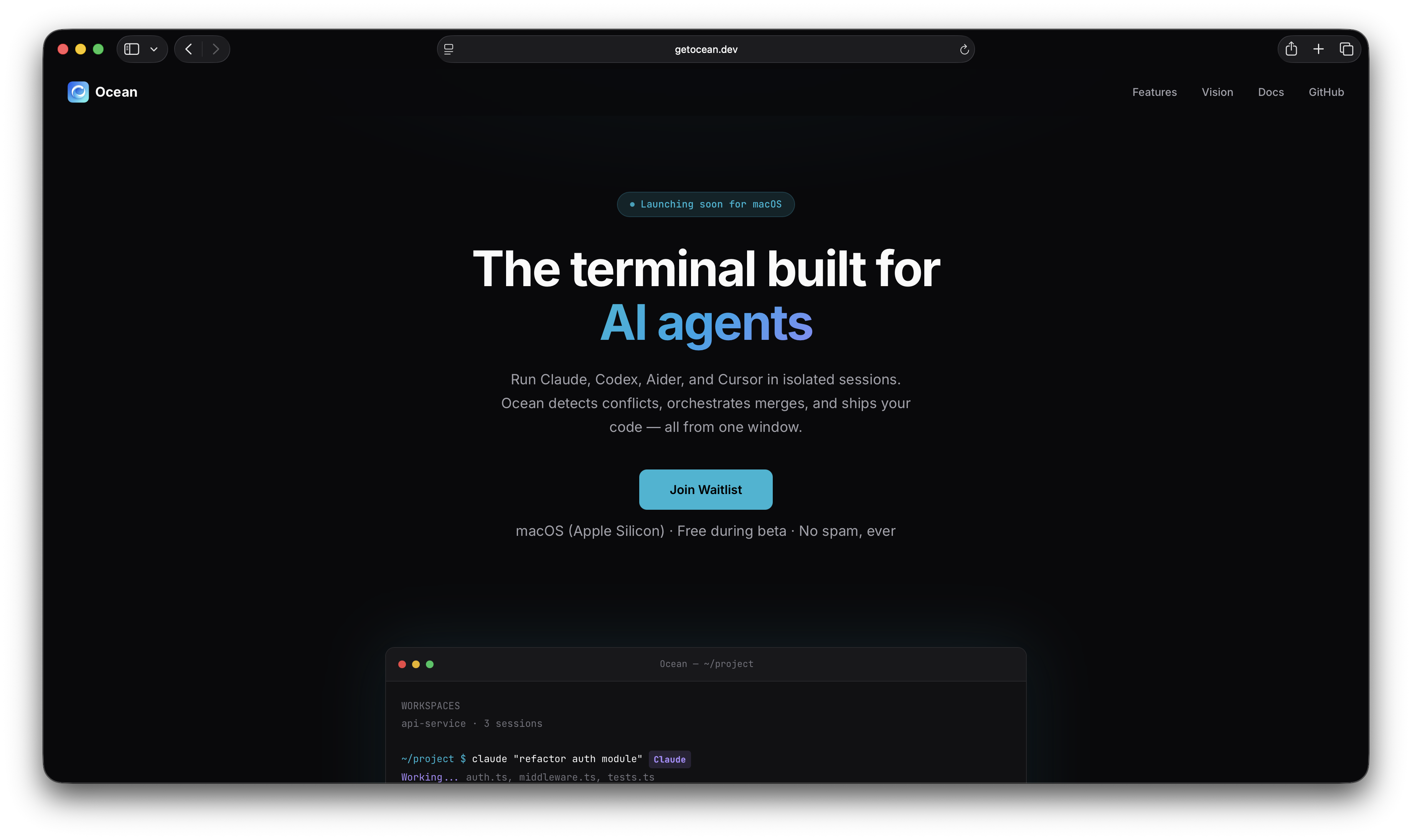
The terminal becomes a reviewable agent cockpit.
Ocean is not another chat wrapper. It is a macOS terminal built around parallel sessions, workspace isolation, merge flow, PR checks, and agent evidence.
From agent task to trusted merge.
The promise is simple: agents can move quickly, but production code only moves through controlled gates.
Scope the task
Start Claude, Codex, Cursor, or Gemini with the workstream and project context it is allowed to touch.
Isolate the lane
Each agent gets its own workspace so experiments do not overwrite each other or corrupt the base repo.
Validate evidence
Tests, checks, spend, risky files, and review state become visible before anyone approves the work.
Merge with control
Ocean guides conflicts and moves only the accepted session back into the canonical workspace.
Let agents move fast. Keep the repo under control.
Start with the macOS app, connect the tools your team already uses, and make every agent session measurable before it reaches production.